1

Ducks and Geese: Standard Breeds and Management — Reading Companion
4
2
Project Gutenberg
2020
Ducks; Geese
Readers of public-domain and historical texts
Project Gutenberg digital edition
en
Edition facts
Words: 20,703
Reading time: 91 min
Text sections: 3
Source:
Project Gutenberg record #62685
A 1897 USDA bulletin by George E. Howard enumerating standard duck and goose breeds with detailed feeding schedules, housing plans, and market-dressing instructions, based on practical experience from Long Island raisers.
Editorial Edition Score
4.6/5
★★★★★
★★★★★
Calculated from edition completeness, EPUB availability, text structure and catalogue metadata. Not a user rating.
Edition quality
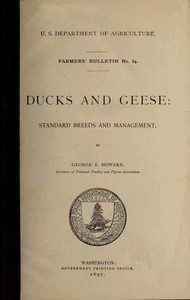
The bulletin opens with a formal letter of transmittal from the Bureau of Animal Industry, dated September 24, 1897, establishing its authority as a government publication. George E. Howard, secretary of the National Poultry and Pigeon Association, enumerates ten standard duck breeds—from White Pekin to Crested White—and seven goose breeds, each accompanied by illustrations drawn from original sketches and photographs. The work is explicitly practical: it aims to provide “suggestions for their management” rather than ornamental or historical commentary.
Breed-by-Breed Descriptions
The first half of the bulletin catalogs each standard breed with a consistent structure: origin, color, weight, and egg production. For example, the White Pekin is described as “the most popular market duck” due to its rapid growth, while the Colored Rouen is noted for its large size and suitability for breeding. Howard includes specific details such as the Black Cayuga’s “beetle-green” sheen and the Crested White’s “crest of feathers” on the head. The descriptions are terse, avoiding narrative flair, and rely on measurable traits like “weight at maturity” and “eggs per year.”
Feeding by the Clock and the Pound
The management section contains the most granular content: four distinct feeding schedules for market ducks, each broken into age intervals (hatching to 5 days, 5 to 20 days, etc.). Ingredients are given in parts by measure—corn meal, wheat bran, beef scraps, sand—with precise percentages. Howard notes that “the duckling grows twice as rapidly and is a much heavier eater than the chick,” justifying the detailed rations. A second system from a Long Island raiser is included, differing only in the use of No. 2 grade flour. Costs are itemized: 6 to 12 cents per pound to raise a market duck at ten weeks, with feed costing 4½ to 5 cents per pound.
Housing, Water, and the Economics of Scale
Howard devotes several pages to infrastructure: “Starting a plant” includes a diagram of a breeding plant, while “Buildings for breeding ducks” and “Brooding houses” provide dimensions and materials. Water supply is emphasized—ducks require “a constant supply of clean water” for drinking and bathing. The section on “Killing and dressing for market” describes methods for plucking and packing, with an illustration of a dressed duck. Throughout, the tone is that of a government advisor: neutral, prescriptive, and cost-conscious.
Geese: Breeds, Cross-Breeding, and Wild Variants
The goose section mirrors the duck section but is shorter, covering seven breeds: Gray Toulouse, White Embden, Gray African, Brown and White Chinese, Gray Wild, and Colored Egyptian. Howard includes a note on cross-breeding, with illustrations from the Rhode Island Experiment Station, and a brief discussion of “mating and setting.” The wild goose is illustrated after Wright’s Book of Poultry, acknowledging external sources. The management advice for geese is less detailed than for ducks, reflecting their secondary role in the bulletin.
Readers should approach this bulletin as a period-specific manual rather than a modern guide. The feeding ratios and cost estimates reflect 1897 prices and practices, but the breed descriptions remain useful for historical reference. Howard’s reliance on experienced raisers like James Rankin and A. J. Hallock grounds the advice in practical, not theoretical, knowledge. For those interested in the evolution of poultry science, this document offers a clear snapshot of late-19th-century waterfowl husbandry.
Reader reflection
How did this book work for you?
Your answers remain private and are stored only in this browser.
Your progress
0
/
10
2
Did this book hold your interest?
3
How likely are you to recommend this book?
4
What was the reading difficulty like?
5
Do you expect to return to this book?
6
How did the reading compare with what you expected?
7
How clear did the writing feel?
8
How useful were the ideas in this book?
9
What did this book teach you most?
10