
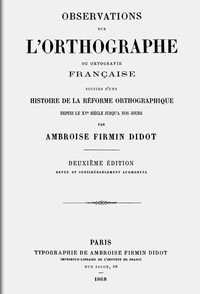
Observations sur l'orthographe ou ortografie française, suivies d'une histoire…
This isn't a novel, but it has all the drama of one. The "plot" is simple: a brilliant and respected printer, Ambroise Firmin-Didot, looks at the French language and sees a system in crisis. He documents the absurd inconsistencies—the silent letters, the illogical rules—and traces how this tangled mess came to be. The real conflict isn't against a villain, but against inertia and tradition. Firmin-Didot makes his case that confusing spelling is a barrier to education and literacy, and then he proposes a cleaner, more phonetic system. The rest of the story is the reaction: the resistance from the establishment and the long, slow battle for change.
Why You Should Read It
You should read it because it makes you see the words on every page differently. Firmin-Didot's passion is contagious. He isn't some stuffy academic; he's a practical man of business who sees a real-world problem. His arguments about access and clarity ring just as true now as they did 150 years ago. Reading his careful, frustrated explanations, you realize the spelling rules we take for granted are often accidents of history, defended by people who just don't want to relearn. It's a humbling and fascinating look at how our most basic tool—language—is shaped by politics and personality.
Final Verdict
Perfect for word nerds, history lovers, and anyone who enjoys a good underdog story. It's not a light beach read, but it's far more engaging than you'd expect a book about orthography to be. You'll come away with a new appreciation for the silent 'h' and a lot of sympathy for every student who has ever struggled to spell. If you like ideas that challenge the status quo, you'll find a champion in Firmin-Didot.
This masterpiece is free from copyright limitations. Share knowledge freely with the world.
Mark Allen
6 months agoGreat reference material for my coursework.
Carol Martinez
1 year agoHigh quality edition, very readable.
Matthew Walker
6 months agoJust what I was looking for.

Thomas Anderson
3 months agoHaving read this twice, it manages to explain difficult concepts in plain English. I learned so much from this.