
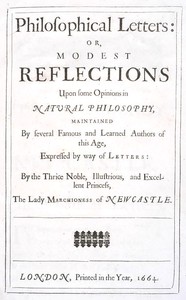
Philosophical Letters: or, modest Reflections upon some Opinions in Natural…
The Story
So Margaret Cavendish, Duchess of Newcastle, was this 17th-century outsider showing up to parties by literally writing books nobody asked for—because she was a woman in 1650 wearing science pants. In Philosophical Letters, she takes a series of heavy philosophic words from guys like Hobbes, More, and Van Helmont and writes back to them, one letter at a time, all made up in her head. There’s no real story arc or romance or drama in the way we think. Instead, it's a running mental dialogue, and each chapter is basically her going, “Okay but... what if ‘matter’ was actually alive and thinking all along?” She invents a practice she calls ‘Converse’, and again and again, she defends the idea that the universe is not dead stuff but filled with feeling, and that not everything can be proven by instruments or dissection. It is controversial, weird, and very nerdy—and that is the story.
Why You Should Read It
Because she’s like a spicy web influencer in a velvet dress, three hundred years early. Her frustration seriously cracks through—she hates people who insist on math or sense perception to understand everything. Sound familiar? Right now, some might say science decides truth. She raises points that we now actually take seriously: like the reality and importance of consciousness, and the things that aren’t explained by gears and math alone. She’s also blunt and funny. At one point, she verbally blasts atom-theory fans (actual rival academics) by saying they build castles in the air. You read that and laugh out loud. She explores big questions—is there a single world-soul? Is God like a clockmaker? But none of it sounds like a dusty lecture. It sounds like two people squabbling at a pub with high stakes. What’s under the floor here is democracy—she fights for the right of ‘fancy’ or wonderful thinking to stand equal to math.
Final Verdict
This book is great (if you’re patient and want to think) as an 8th grader having dinner with a mad scientist. It goes weird, sometimes wrong but her freedom will rock you if you love Margaret Atwood, philosophy, sci-fi history-lore or root-for-the-underdog stuff. Reading it helps you understand the messy beginnings of both misogyny and free thought. Still? Her hidden gem makes you wonder—maybe we lost some kindness in the name of ‘rigor’. Perfect for history nuts, sci-comm readers, proud contrarians, and for that hip cousin who says “Girl, you gotta read some 1650 radical philosophy.” Bookmark or take head notes and read a letter at a time—but do read her defiant bright messy world of knowing.”
This is a copyright-free edition. Preserving history for future generations.
Patricia Miller
6 months agoIt took me a while to process the complex ideas here, but the step-by-step breakdown of the methodology is extremely helpful for students. This should be on the reading list of every serious professional.