1

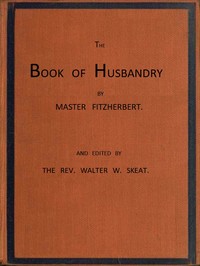
The Book of Husbandry — Context and Discussion
4
2
Project Gutenberg
2018
Conduct of life; Agriculture -- England; Home economics, Rural
Readers of public-domain and historical texts
Project Gutenberg digital edition
en
Edition facts
Words: 74,704
Reading time: 325 min
Text sections: 19
Source:
Project Gutenberg record #57457
Fitzherbert's 1534 manual on farming and estate management, structured as a series of practical observations and instructions, with a focus on daily routines, record-keeping, and oversight of servants and land.
Editorial Edition Score
4.8/5
★★★★★
★★★★★
Calculated from edition completeness, EPUB availability, text structure and catalogue metadata. Not a user rating.
Edition quality
Fitzherbert's Book of Husbandry (1534) opens with a prologue that immediately establishes a practical, experience-based authority: the author asserts that practice is better than theory, citing the maxim that the knowledge of a well-proven husbandman surpasses that of an unproven philosopher. The work is structured as a series of discrete sections, each addressing a specific aspect of rural management—from plowing and sowing to the oversight of servants and the maintenance of hedges and gates. The text is punctuated by recurring images of the diligent landowner walking his fields, tables in hand, noting defects to be amended. This movement between scenes—from the pasture to the cornfield, from the sheepfold to the house—creates a rhythm of constant inspection and correction that defines the book's practical ethos.
The Walking Surveyor
A distinctive structural feature of the Book of Husbandry is its repeated emphasis on the landowner's physical movement through his property. Fitzherbert advises the reader to rise early and go about his closes, pastures, and fields, especially by the hedges. This is not a static manual but a guide to a mobile, observant practice. The author recommends carrying a pair of tables (a notebook) to record anything amiss: a gap in a hedge, standing water in a pasture, or stray animals. The act of walking and noting is presented as a daily discipline, one that the author claims to have followed for ten or twelve years. This emphasis on movement and inspection gives the book a procedural structure, where each section builds on the idea that good husbandry is a continuous process of seeing, recording, and correcting.
The Mnemonic Verse and the Servant's Gear
Among the more curious recurring details is the inclusion of a hexameter verse designed to help a gentleman's servant remember his belongings when taking a horse: "Pvrse, dagger, cloke, nyght-cap, kerchef, shoyng-horne, boget, and shoes." This list, embedded in a section on household management, exemplifies Fitzherbert's attention to the concrete and the memorizable. The verse is a mnemonic device, but it also reveals a concern with the movement of people and goods between house and inn. The servant's gear—a purse, a dagger, a cloak—are objects that travel, and the verse ensures they are not left behind. This small detail reflects a broader pattern in the book: the use of lists, tables, and rhymes to fix knowledge in a world where writing may not be universal. Fitzherbert even suggests that those who cannot write should "nycke the defautes vppon a stycke"—a notched stick as a memory aid.
The Household as a Site of Surveillance
The Book of Husbandry repeatedly turns its attention to the interior of the house and the behavior of servants. Fitzherbert advises the master to take note of all who come to his house, especially those carrying pitchers, cans, tankards, bottles, bags, wallets, or bushel-pokes—containers that could be used to steal grain or goods. The house is a place of potential loss, and the master must be vigilant. The text warns that if servants are not true, they may do great hurt while gaining little advantage. A true servant, by contrast, will correct his fellows and report misdeeds to the master. This emphasis on loyalty and oversight creates a social structure within the household that mirrors the careful management of fields and livestock. The movement between outdoor and indoor scenes—from the pasture to the pantry—gives the book a comprehensive scope, covering both the productive and the domestic economies.
The Editor's Frame: Skeat's 1882 Edition
The present edition, edited by Walter W. Skeat in 1882, adds a layer of scholarly apparatus that frames the original 1534 text. Skeat's introduction discusses the authorship question—whether Fitzherbert is the same Sir Anthony Fitzherbert who wrote legal works—and notes that the text is a reprint of Berthelet's edition collated with a later 1598 edition. The editor has inserted corrections in brackets and retained original spelling variations and line numbers. The notes and glossarial index provide modern English explanations for obsolete terms. This editorial structure, with its careful attention to textual history, contrasts with the practical, immediate tone of the original. Readers encounter the 1534 text through a Victorian lens, with Skeat's scholarly voice mediating the early modern instructions. The result is a work that is both a historical document and a practical manual, its meaning shaped by the editorial choices of its later editor.
Readers approaching this edition should attend to the interplay between Fitzherbert's original text and Skeat's editorial interventions. The line numbers and footnotes invite a careful, comparative reading, while the glossarial index helps decode the early modern vocabulary. The book rewards those who follow its own advice: to walk through its sections slowly, noting defects and amendments, and to consider how the practical knowledge of a sixteenth-century husbandman might still inform our understanding of land, labor, and household management.
Reader reflection
What did you think of this book?
Answer a few questions and save a private reflection on this device.
Your progress
0
/
10
2
How much did you enjoy the reading experience?
3
Would you encourage someone else to read it?
4
How easy was the book to follow?
5
What was its emotional impact?
6
How distinctive were its ideas or approach?
7
How did the pace of the book feel?
8
How did the reading compare with what you expected?
9
In one sentence, what did you learn?
10