1

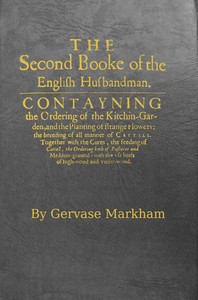
The English Husbandman (The Second Booke) — Text and Context
5
2
Project Gutenberg
2023
Agriculture -- England -- Early works to 1800; Agriculture -- Early works to 1800; Gardening -- England -- Early works to 1800; Gardening -- Early works to 1800
Readers of public-domain and historical texts
Project Gutenberg digital edition
en
Edition facts
Words: 42,668
Reading time: 186 min
Text sections: 22
Source:
Project Gutenberg record #69970
Gervase Markham's 1614 manual on kitchen gardens, livestock, and woodland management, structured by seasonal signs, practical advice, and recurring emphasis on husbandly caution and profit.
Editorial Edition Score
4.9/5
★★★★★
★★★★★
Calculated from edition completeness, EPUB availability, text structure and catalogue metadata. Not a user rating.
Edition quality
Gervase Markham's The English Husbandman (The Second Booke) opens not with soil or seed but with a chapter on weather signs: how to foreknow rain, snow, tempests, and fair weather from clouds, moon, sun, beasts, and even things without motion. This structural choice frames the entire work as a guide to timing—when to sow, cut wood, or breed cattle depends on reading the sky. The book then moves through kitchen-garden layout, pot herbs, strange flowers, livestock breeding, and woodland sale, each section governed by the same principle: the husbandman must shape his garment according to his cloth.
Signs and Seasons as Structural Backbone
The first chapter, occupying a full table of contents alone, establishes a pattern that recurs throughout: the husbandman's knowledge begins with observation. Markham lists signs of rain from clouds, the moon, the sun, lightning, fowls, beasts, and things without motion—a methodical taxonomy that mirrors the later divisions of garden beds and woodlots. He extends this to seasonal prognostication: signs of a forward or backward year, of a good or bad year, even from Christmas day and St. Paul's day. This is not superstition but a practical calendar, linking celestial and terrestrial cycles. The same logic governs later advice: cutting wood from late January to mid-April, when the leaf begins to bud, or from September to mid-November, when it sheds. The structure of the book itself—moving from general signs to specific tasks—enacts the husbandman's need to read the world before acting.
The Garden as Ordered Space
Markham's kitchen garden is a place of deliberate arrangement. He devotes chapters to the choice of ground, trenching, breaking mould, and ordering beds, each step a microcosm of the larger husbandry. The garden's 'fruitfull soyle' is not given but made through labor: trenching, manuring, and careful sowing. He lists pot herbs in a sequence that reads like a catalogue—Endive, Succory, Beets, Land-Cresses, Parcely, Sauory, Time—each with brief notes on cultivation. The inclusion of 'strange flowers' alongside staples suggests a garden that balances utility with ornament. The 'necessariest ornament' is not a fountain or statue but the order itself: beds laid out for easy access and rotation. This practical aesthetic recurs in the woodland section, where he advises preserving fruit trees like pears and chestnuts, clearing them from the droppings of taller trees for profit.
Woodland as Long-Term Investment
The discussion of under-wood and high-wood reveals Markham's concern with sustainability and profit over decades. He calculates that an acre of twenty-one years' growth may be worth twenty or thirty pounds, while seventeen-year wood brings eight or ten, and twelve-year only five or six. The husbandman must balance necessity—fuel and fence—against the greater profit of waiting. 'Shape his garment according to his cloth' is the recurring maxim: take plenty where plenty is, but with caution. Markham advises cutting only one acre per year from twelve acres, lest the wood be spoiled. He details the sale of under-wood by acres, roods, perches, poles, roddes, or dozens, but refuses to set a fixed price, insisting that 'true judgement' and the goodness of the wood must direct the seller. This blend of specific method and flexible principle characterizes the entire work.
The Husbandman's Eye and Hand
Throughout, Markham emphasizes the husbandman's direct judgment over rote rule. In woodland management, he instructs the wood-faller to preserve the fairest sapling from a cluster, to prune superfluous branches, and to cut slope-wise six inches above ground to hasten the new spring. The same attention appears in livestock breeding and feeding, though the excerpts are partial. The book's voice is that of an experienced practitioner speaking to a peer: 'there be fewe Husbands but know' that older wood is richer, yet necessity may force earlier cutting. Markham does not prescribe a single method but offers principles adaptable to local conditions. The recurring image is of the husbandman moving through his land—reading clouds, inspecting soil, selecting timber—each action informed by accumulated observation. This is not a theoretical treatise but a working manual, its structure mirroring the cyclical, patient labor it describes.
Profit and Caution in Every Chapter
Markham's advice is consistently framed by the tension between immediate need and long-term gain. In the garden, he warns against over-planting; in the wood, against cutting too much too soon. The phrase 'husbandly caution' appears in the woodland section, and the same spirit pervades the weather signs: knowing when a storm is coming allows the husbandman to protect his crops and livestock. Even the sale of under-wood is hedged with conditions—the buyer's ability, the wood's quality, the season. Markham's ideal reader is not a passive follower of instructions but an active judge, capable of adapting general rules to particular circumstances. This emphasis on prudence and observation gives the book a consistent ethical dimension: good husbandry is not just technique but a way of life rooted in attentiveness to the natural world.
Readers approaching The English Husbandman will find a work that rewards slow, attentive reading—much like the husbandry it describes. The book's structure, moving from weather signs to garden beds to woodland cycles, invites the reader to see each task as part of a larger seasonal rhythm. Markham's voice is direct and practical, but his principles are flexible, leaving room for the reader's own judgment. This is not a book to be skimmed for quick tips but to be consulted as a companion to the working year.
Reader reflection
How will you remember this book?
Save your reaction, strongest insight, and memorable passage.
Your progress
0
/
10
2
Was reading this book enjoyable?
3
Would you recommend this book to another reader?
4
What was the reading difficulty like?
5
Would you like to discuss this book with someone?
6
Which aspect of the book did you value most?
7
Could you see yourself revisiting this book?
8
How did the pace of the book feel?
9
Which lesson or insight stayed with you?
10