1

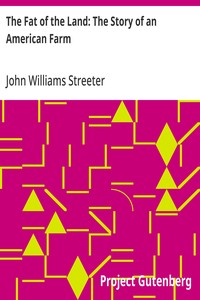
The Fat of the Land: The Story of an American Farm — Reading Companion
6
1
Project Gutenberg
2005
Agriculture
Readers of public-domain and historical texts
Project Gutenberg digital edition
en
Edition facts
Words: 97,778
Reading time: 426 min
Text sections: 9
Source:
Project Gutenberg record #16525
A first-person account of establishing an intensive farm in late-19th-century America, structured as a series of practical episodes. The narrator defends confinement systems for hogs, cows, and hens against free-range ideals, arguing that controlled conditions yield better health and profit. The text moves between detailed husbandry and broader economic reasoning.
Editorial Edition Score
4.8/5
★★★★★
★★★★★
Calculated from edition completeness, EPUB availability, text structure and catalogue metadata. Not a user rating.
Edition quality
The narrator of The Fat of the Land opens his account at age sixty, having “more than half descended the western slope,” and immediately establishes a tone of pragmatic reflection. Rather than a nostalgic pastoral, the book proceeds as a sequence of titled, often short chapters—sixty-seven in all—each focused on a discrete task or decision: boring for water, plowing, fencing, hatching chickens. This structure mirrors the incremental, hands-on process of building a farm from scratch, and the narrator’s voice is consistently that of a manager who weighs costs, methods, and outcomes.
A Chapter-by-Chapter Blueprint
The book’s organization is itself a kind of farm journal. Chapter titles such as “Boring for Water,” “We Plat the Farm,” “House-Cleaning,” and “Fenced In” read like entries in a work log. The narrator moves from one concrete problem to the next, rarely pausing for extended reflection. This episodic structure gives the reader a sense of the farm’s gradual materialization: each chapter solves a problem or completes a phase, and the cumulative effect is one of steady, deliberate construction. The table of contents, with its sixty-seven headings, functions almost as a checklist of the farmer’s year.
The Case for Confinement
A recurring argument in the excerpts is the narrator’s defense of intensive, confined animal husbandry. He contends that the “well-yarded hen” has a better life than the free-range bird, which faces “the hawk and the owl; the fox, the weasel, the rat, the wood pussy, the cat, and the dog.” Similarly, he argues that hogs and cows are “better off under the constant care of intelligent and interested human beings” than when left to graze. The language is blunt: “The pig is born to die, and to die quickly, for the profit and maintenance of man.” These passages reveal a worldview that prioritizes efficiency and control over traditional pastoral ideals.
Movement Between Indoor and Outdoor Scenes
The narrative shifts frequently between the farm’s built structures—the stable, the hennery, the piggery—and the fields, orchards, and pastures. In the excerpts, the narrator moves from describing a “cool stone porch” for pigs to the “rippling brook” and “lea” of the grazing farm, then back to the “clean, cool, calm stable” for cows. This back-and-forth underscores a central tension: the narrator’s farm is a place of deliberate enclosure and management, yet the natural world—weather, predators, seasons—constantly intrudes. The physical movement between house, barn, and field becomes a structural rhythm, reinforcing the theme of human effort against natural forces.
Recurring Images of Measurement and Calculation
Throughout the excerpts, the narrator quantifies nearly everything: the hog’s “250 days” to market, the “twenty-acre lot” for fifty cows, the “nine months of life” for a pig. He speaks of “well-balanced, well-cooked food” and “uniform flow of milk” as products of a system. This habit of measurement extends to labor and economics: “the multiplication of well-paid and well-paying labor is a thing to be specially desired.” The farm is presented as a factory, and the narrator’s language—terms like “intensive farming,” “soiling,” and “factory-farm man”—reinforces an image of agriculture as a calculable, optimizable enterprise.
Readers approaching The Fat of the Land should expect a practical, opinionated narrative that treats farming as a business and a craft. The book’s strength lies in its specific, often contentious observations about animal husbandry and land management. Because the excerpts are limited, the full arc of the farm’s development—and whether the narrator’s methods succeed—remains to be discovered. The work rewards attention to its structural details and the recurring tension between confinement and freedom.
Reader reflection
What did you think of this book?
Answer a few questions and save a private reflection on this device.
Your progress
0
/
10
2
Was reading this book enjoyable?
3
Would you recommend this book to another reader?
4
Did the language feel accessible?
5
Could you follow the author’s main argument?
6
Would you start a conversation about this book?
7
Was the book what you thought it would be?
8
How original did the book feel?
9
Which lesson or insight stayed with you?
10