1

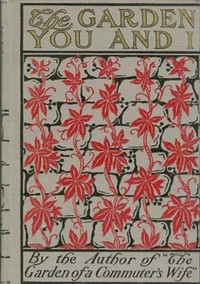
The Garden, You, and I — Edition Insights
4
0
Project Gutenberg
2006
Gardening
Readers of public-domain and historical texts
Project Gutenberg digital edition
en
Edition facts
Words: 88,820
Reading time: 387 min
Text sections: 10
Source:
Project Gutenberg record #17514
This editorial note examines how Mabel Osgood Wright structures her gardening narrative through alternating chapters of practical advice and fictional episodes, using recurring images of wind, cages, and fairy lore to connect the garden with domestic life.
Editorial Edition Score
4.9/5
★★★★★
★★★★★
Calculated from edition completeness, EPUB availability, text structure and catalogue metadata. Not a user rating.
Edition quality
Mabel Osgood Wright's The Garden, You, and I alternates between practical gardening chapters and fictional interlaced letters between two women, Barbara and Mary Penrose. The book opens with a poem personifying wind as a ruler that must be consulted when setting garden boundaries, establishing a pattern where natural forces are given agency. The structure itself mirrors this interplay: chapters on hardy plants or rose gardens are separated by narrative episodes such as "Their Garden Vacation" or "A Midnight Adventure," creating a rhythm of instruction and story.
Wind as a Structural and Thematic Force
The opening chapter, "The Ways of the Wind," declares that wind and water are the two rulers to be consulted when land is set apart for a garden. This is not merely a poetic flourish; throughout the excerpts, wind recurs as a presence that shapes both the garden and the characters' experience. In the letter from Mary Penrose, she describes sleeping on a bank "overlooking the Opal Farm" under the open sky, directly exposed to the wind. The wind is also invoked in the dedication's Whitman epigraph: "Allons! the road is before us! It is safe—I have tried it." Wright uses wind to connect the garden to the larger landscape, suggesting that the gardener must work with, not against, these elemental forces.
The Cage and the Open: Domestic Boundaries
Mary Penrose's letter contrasts her indoor bedroom—"a cage" despite its three windows and white matting—with the freedom of sleeping outdoors. This image of the cage recurs in her description of the Infant's crib being "under cover" while the adults sleep under the stars. The tension between enclosure and openness mirrors the garden itself, which is a bounded space yet open to the sky. Wright uses this dichotomy to explore how domestic life can feel confining even when physically comfortable, and how the garden offers a release. The Infant's desire to bring mice indoors for her "fairlies" further blurs the line between wild and domestic, as she insists that mice are really fairy horses.
Fairy Lore and the Child's Perspective
The Infant's elaborate fairy mythology—that mice are horses for fairies, that cobwebs become too sharp for riding in cold weather, and that fireflies and candle worms serve as lanterns—is presented with a straight face. Wright does not dismiss this as childish fancy; instead, Mary Penrose records it with a mixture of amusement and wonder. The passage echoes the book's larger interest in the invisible life of the garden. Just as the gardener must attend to soil, roots, and wind, the child attends to the needs of fairies. This parallel suggests that gardening itself requires a kind of faith in unseen processes. The excerpt also includes a poem about "nimble fay and pranksome elf" appearing at every turn, reinforcing the idea that the garden is a place of enchantment.
The Movement Between Instruction and Narrative
The book's structure is unusual for a gardening manual: it intersperses practical chapters on topics like "Ferns, Fences, and White Birches" with story chapters that advance the lives of Barbara and Mary. For instance, Chapter IX on ferns is followed by Chapter X, "Frankness—Gardening and Otherwise," which is a letter from Mary describing her midsummer night. This alternation means that the reader moves from specific advice—"Don't bother about the tops, for new ones will grow, but look to the roots"—to a personal narrative about sleeping in a barn. The effect is to embed gardening knowledge within a lived experience, making the advice feel less like a lecture and more like a conversation between friends. The appendixes listing hardy seeds and annuals further blur the line between reference and memoir.
Readers will find that The Garden, You, and I rewards attention to its structure as much as to its plant lists. The movement between practical chapters and fictional interludes creates a dialogue between knowledge and imagination. Pay particular attention to how the wind, the cage, and the fairy lore recur across both modes, binding the book together into a single meditation on what it means to cultivate a garden—and a life.
Reader reflection
How did this book work for you?
Your answers remain private and are stored only in this browser.
Your progress
0
/
10
2
Did this book hold your interest?
3
Would you recommend this book to another reader?
4
How easy was the book to follow?
5
Did you relate to its people, ideas, or situations?
6
Did the book meet your expectations?
7
Did you gain anything practical from the text?
8
Could you see yourself revisiting this book?
9
In one sentence, what did you learn?
10