1

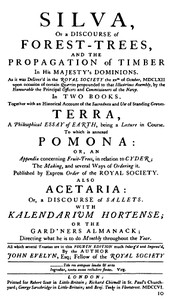
Sylva; Or, A Discourse of Forest Trees. Vol. 1 (of 2) — Key Ideas to Explore
1190
2
Project Gutenberg
2007
Gardening -- Early works to 1800; Forests and forestry -- Early works to 1800; Trees -- Early works to 1800
Readers of public-domain and historical texts
Project Gutenberg digital edition
en
Edition facts
Words: 140,922
Reading time: 613 min
Text sections: 17
Source:
Project Gutenberg record #20778
John Evelyn's 1664 discourse on forest trees, structured as a series of chapters on individual species, combines practical cultivation advice with classical references and folk remedies. The work moves between detailed planting instructions and digressions on medicinal uses, reflecting a 17th-century naturalist's encyclopedic approach.
Editorial Edition Score
4.8/5
★★★★★
★★★★★
Calculated from edition completeness, EPUB availability, text structure and catalogue metadata. Not a user rating.
Edition quality
John Evelyn's Sylva proceeds tree by tree, each chapter a self-contained treatise on a single species. The work opens with general chapters on soil and nursery practice before launching into a sequence: Oak, Elm, Beech, Horn-beam, Ash, and so on. This structure gives the reader a sense of methodical inventory, yet within each chapter the text ranges widely—from precise instructions on seed storage and transplanting to classical quotations, folk remedies, and observations on timber uses. The chapter on the Walnut, for instance, moves from burying nuts in leaden pots to a cure for dysentery used by the English army in Ireland, all within a few paragraphs.
From Seed to Remedy: The Walnut Chapter's Range
The Walnut chapter exemplifies the work's characteristic movement between practical horticulture and unexpected digressions. Evelyn advises on preserving nuts for a seminary—keeping them 'a little moist, that they may spear, to be set early in February'—and then shifts to medicinal uses: the kernel 'a little masticated' applied to a mad-dog bite, or the fungus from an old tree made into touch-wood. The text also records that 'the juice of the outward rind of the nut, makes an excellent gargle for a sore-throat.' These leaps from planting to pharmacy are not anomalies; they recur throughout the volume, suggesting that Evelyn conceived of tree knowledge as encompassing both husbandry and natural magic.
Recurring Images: The Tree as a Storehouse of Uses
A persistent image in the excerpts is the tree as a source of multiple, often surprising products. The Walnut yields oil, dye from green husks, a hair tonic from distilled leaves, and a stopper for leaking vessels—'better than either clay, pitch, or wax.' The chapter on the Service-tree notes that the sower 'never sees the fruit of his labour' because the tree bears only when very old. This image of delayed return contrasts with the immediate utility catalogued elsewhere. Evelyn's prose repeatedly draws attention to the tree's body as a repository of latent benefits, waiting to be extracted through proper knowledge.
Movement Between Erudition and Observation
Evelyn's voice shifts between the scholarly and the empirical. He cites Servius, Macrobius, and Juvenal within the Walnut chapter, yet also reports firsthand or contemporary accounts: the cure for dysentery from the 'fungus substance separating the lobs of the kernel' is attributed to the English army in Ireland. The text includes references to the Philosophical Transactions and to Mr. Ray's Dendrologia, grounding its claims in both ancient authority and recent experiment. This dual movement—from classical quotation to practical note—gives the discourse a layered texture, where a line from Juvenal about a walnut tree felled by the wind sits beside a recipe for blanching nuts in warm water.
The Work's Architectural Logic
The volume's table of contents reveals a clear architectural logic: Book I moves from general principles (soil, seed, transplanting) to a parade of individual trees, each given its own chapter. The order is not alphabetical but follows a perceived hierarchy or utility, beginning with the Oak. Within each chapter, the pattern is consistent: naming of species, methods of raising, transplanting, and then a catalogue of uses. This repetitive structure allows the reader to compare treatments across species. The presence of a commentator, John Nisbet, adds a later layer of editorial framing, but the core text retains its 17th-century organization, inviting the modern reader to move through it as a systematic reference.
Readers approaching Sylva for the first time may find it useful to treat each chapter as a standalone essay rather than expecting a continuous argument. The work rewards browsing: one can open to any tree and find a compact world of planting lore, classical allusion, and domestic remedy. The index of contents provides a clear map, but the real pleasure lies in Evelyn's digressions—those moments when a note on walnut oil leads to a cure for pleurisy, or a remark on service-berries turns into a meditation on patience.
Reader reflection
What did you think of this book?
Answer a few questions and save a private reflection on this device.
Your progress
0
/
10
2
Was reading this book enjoyable?
3
How likely are you to recommend this book?
4
How easy was the book to follow?
5
Would this book work well in a reading group?
6
Could you see yourself revisiting this book?
7
Which part made the strongest impression?
8
What was its emotional impact?
9
What changed or sharpened your thinking?
10