1

Texas Honey Plants — A Reader’s Guide
32
2
Project Gutenberg
2012
Bee culture; Honey plants -- Texas
Readers of public-domain and historical texts
Project Gutenberg digital edition
en
Edition facts
Words: 11,199
Reading time: 49 min
Text sections: 3
Source:
Project Gutenberg record #39357
A 1908 agricultural bulletin cataloging Texas honey plants with botanical descriptions, bloom times, and beekeeping notes. The authors' terse, observational style blends scientific taxonomy with practical field reports, revealing the uneven yields and seasonal rhythms that shape Texas apiculture.
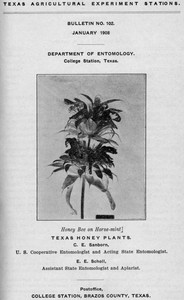
The bulletin opens not with a flourish but with a bureaucratic roll call: the governing board of the Texas Agricultural Experiment Stations, the station officers, and a preface that traces the work through four entomologists' tenures. This institutional framing sets a tone of methodical, collaborative science. The authors, Sanborn and Scholl, then proceed to list honey plants in a compressed format—Latin name, common name, family, a brief habitat note, and a terse assessment of honey yield. The voice is that of a field observer, not a literary naturalist: entries such as “honey yield good but pollen attaches to bee's feet and cripples them” convey practical knowledge with blunt economy.
A Catalog of Yields and Seasons
The bulletin’s core is a list of plants, each entry a miniature report. The authors consistently grade honey yield with adjectives like “good,” “light,” “sparing,” or “very heavy of fine quality but very short duration.” Bloom months are given as ranges—May to November for White Brush, June to November for Morning Glory—revealing the long, staggered flowering seasons of Texas. Some entries note bee behavior: bumble bees visit Blue Sage more than honey bees; Silk Weed’s pollen “cripples” bees. The language is observational, not explanatory; the reader must infer the ecological implications.
Voice of the Field Observer
The authors’ prose is lean, almost telegraphic. Entries often begin with a location (“College: cultivated ornamental shrub on campus”) or a habitat (“On light soils of Southwest Texas”). They cite botanists Coulter and Small for distribution, but the yield assessments are their own. The preface credits Louis H. Scholl for most of the data, and his mark (*) follows certain entries. This layered authorship—Sanborn and Scholl compiling, with earlier collectors acknowledged—gives the bulletin a cumulative, collaborative texture. The voice is that of a working apiarist, not a poet: “A few bees visited it. Soon died.”
Pace and Structure: The Bulletins Within
The bulletin’s pace is steady, each plant entry a discrete unit. But the text is interrupted by two long sections of Project Gutenberg boilerplate—copyright, license, donation requests—that break the flow. These are artifacts of the digital edition, not the original. The original bulletin likely had a continuous list. The entries themselves vary in length: some are a single line, others include notes on cultivation or bee damage. This irregularity mirrors the uneven importance of each plant to beekeeping. The authors do not rank or prioritize; they simply record, leaving the reader to weigh the evidence.
Readers should approach this bulletin as a primary source for early twentieth-century Texas apiculture. The terse entries reward slow reading: each yield grade and bloom month is a data point. The authors’ restraint—no grand conclusions, no recommendations—leaves the practical application to the beekeeper. For modern readers, the value lies in the specificity: a record of plants and their honey potential, unvarnished by later interpretation.
Reader reflection
What was your reading experience?
Capture what you thought, learned, and would like to remember.
Your progress
0
/
10
2
How did the book work for you overall?
3
Would you encourage someone else to read it?
4
How easy was the book to follow?
5
Did the book offer a fresh perspective?
6
What was the strongest part of the book?
7
Could you see yourself revisiting this book?
8
Would this book work well in a reading group?
9
What is the main idea you are taking away?
10