1

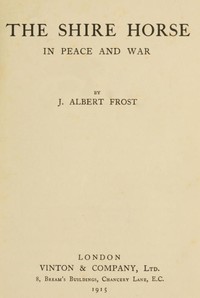
The Shire Horse in Peace and War — Story, Setting & Ideas
1105
2
Project Gutenberg
2015
Horses; Shire horse
Readers of public-domain and historical texts
Project Gutenberg digital edition
en
Edition facts
Words: 26,996
Reading time: 118 min
Text sections: 4
Source:
Project Gutenberg record #49078
Frost's 1915 manual on Shire horse management, blending breeding records, show-ring anecdotes, and wartime context, with a focus on practical farm advice and the breed's historical role as Britain's 'War Horse.'
Editorial Edition Score
4.5/5
★★★★★
★★★★★
Calculated from edition completeness, EPUB availability, text structure and catalogue metadata. Not a user rating.
Edition quality
J. Albert Frost opens his 1915 manual with a farmer's frankness: he writes for those who prefer 'practical advice to literary merit.' The book's structure mirrors this ethos, moving from stud selection to show-ring tactics, then to historical records and wartime service. Frost, writing under the initials 'S. H. L.' (Shire Horse Lover), draws on his own prize-winning article 'Rent-Paying Horses' and decades of livestock journalism. The text is punctuated by precise sale prices, auction dates, and pedigrees—details that ground the narrative in the economics of early twentieth-century horse breeding.
From Farm to Show Ring: The Practical Arc
The book's chapters follow a logical progression from founding a stud to exhibiting at shows, but Frost repeatedly circles back to the working farm. In 'Team Work,' he insists that a Shire's value is proven in the field, not just under the judge's eye. The structure thus mirrors the dual identity of the breed: a show animal and a draft horse. Frost's own career—from a schoolboy enthusiast to a prize-winning writer—echoes this blend of passion and pragmatism. He includes tables of auction averages, such as the Tring Park draft of 1913 where 32 Shires averaged £454, but always ties these figures back to the farmer's bottom line.
Recurring Images: The 'War Horse' and the Plough
Frost repeatedly invokes the 'old War Horse of Britain,' linking the Shire to medieval destriers and contemporary artillery horses. This image recurs alongside the plough horse, creating a tension between peace and war that reflects the book's 1915 publication date. The preface acknowledges that 'little is read but war news,' yet Frost insists on the Shire's relevance to both farm and front. He notes that 'true descendants' of the war horse are 'actively engaged in moving tons and guns,' a phrase that collapses centuries into a single image. The book's illustrations—like the photograph of Champion's Goalkeeper—reinforce this duality: a show champion that could also pull a gun carriage.
Movement Between Scenes: Auction, Show, and Stable
Frost's narrative moves rapidly between auction rings, show grounds, and breeding stables, often within a single paragraph. The chapter 'A Few Records' lists ten notable sales with their dates and averages, then shifts to the career of the mare Pailton Sorais, detailing her placings from yearling to seven-year-old. This restless movement mirrors the itinerant life of a Shire breeder: traveling to Tring Park, Sandringham, or the London show. Frost's prose itself mimics this motion, jumping from a 900-guinea yearling to a 4100-guinea stallion without transition. The effect is a mosaic of data points that collectively argue for the breed's economic viability.
The Breeder's Voice: Numbers and Anecdotes
Frost's authority rests on his command of figures—sale prices, stud book entries, show results—but he leavens these with personal asides. He recalls winning a prize for 'Rent-Paying Horses' in 1899 and notes that his initials 'S. H. L.' mean 'Shire Horse Lover.' This blend of statistical rigor and autobiographical detail gives the book a distinctive voice: that of a farmer who has 'been that from my school days.' The chapter 'Origin and Progress of the Shire' traces the breed's lineage through the Stud Books, yet Frost never loses sight of the practical breeder. He advises on selecting sires and rearing fillies with the same matter-of-fact tone he uses to record a 1200-guinea mare.
Frost's manual resists easy categorization: part breeding guide, part historical record, part wartime reflection. Readers interested in agricultural history will find a wealth of primary data—sale prices, pedigrees, and show results—while those studying the home front during World War I will note how Frost frames the Shire as a national asset. The book's structure, with its abrupt shifts between practical advice and statistical tables, rewards a nonlinear reading. Dip into the chapters on feeding or foot care for hands-on detail, or browse the sale records for a glimpse of Edwardian horse economics.
Reader reflection
How will you remember this book?
Save your reaction, strongest insight, and memorable passage.
Your progress
0
/
10
2
Did this book hold your interest?
3
Would you recommend this book to another reader?
4
How easy was the book to follow?
5
How clearly were the main ideas presented?
6
Did anything about the book feel genuinely new?
7
What did you think about the pace?
8
Would this book work well in a reading group?
9
Which lesson or insight stayed with you?
10